
A World Series ticket buys admission to a baseball game. For the fan purchasing it, however, the transaction can mean something much bigger: a childhood promise, a trip with a parent, or the opportunity to watch a team finally win a championship.
That emotional value helps explain the prices confronting supporters of the Milwaukee Brewers and Tampa Bay Rays. Their 2026 meeting guarantees a first championship for one franchise. Milwaukee is returning to the World Series for the first time since 1982; Tampa Bay previously appeared in 2008 and 2020. Game 1 is scheduled for October 23 in Milwaukee. [[1]](#source-1)
But how much should a fan actually expect to spend? The answer depends on the city, game, seat and buying moment—and whether attending requires a flight and hotel. All amounts below are U.S. dollars unless otherwise stated. Current prices are reported snapshots, not guaranteed offers.
What are tickets costing in 2026?
Reporting published October 19 put Milwaukee’s Game 1 entry price near $2,800. Front Office Sports cited a $2,809 get-in price using TicketData, with lower-level seats generally starting above $4,000. Forbes separately reported a $2,842 minimum on SeatGeek. Those are different observations of a moving resale market, rather than a single official price. [[2]](#source-2)[[3]](#source-3)
Tampa Bay offered a less expensive route in the Forbes snapshot: Game 3 started at $1,011 including fees, while Game 4 started at $980. A fan choosing between venues could therefore face a difference approaching $1,800 for admission alone. The comparison is between different games and dates, so it should guide investigation rather than settle a purchase. [[3]](#source-3)
For two people, the consequences multiply quickly. Using round planning figures of $2,800 in Milwaukee and $1,000 in St. Petersburg, a pair of tickets would consume $5,600 or $2,000 before travel. These rounded amounts illustrate the reported price gap; they are not new listings or confirmed transaction prices.
Face value, asking price and actual sales are different
Ticket discussions become confusing when three distinct figures are treated as interchangeable. Face value is the price charged through the original ticket sale. A resale asking price is what a seller hopes to receive. A completed sale records what a buyer actually paid.
An average adds another complication. An average of remaining listings can be inflated by premium seats or ambitious sellers. An average of completed transactions describes a different pool of tickets. Neither automatically tells a budget-conscious supporter the cheapest available way into the stadium.
“Get-in” prices also need context. Is the listing for an assigned seat or standing room? Must the buyer purchase two tickets? Is the view restricted? Are mandatory charges included? A headline number becomes useful only after those questions are answered.
This matters especially when someone claims one World Series is the most expensive ever. Comparing this year’s minimum asking price with another year’s average sale price can create a dramatic headline without producing a fair historical comparison.
Why Milwaukee’s long wait matters
A championship drought creates demand that an ordinary regular-season schedule cannot reproduce. Milwaukee supporters have watched generations of players without another Brewers World Series appearance. The opportunity to attend a home game now carries a sense of rarity that cannot be measured simply by the opponent’s payroll.
For some families, this is a chance to take a parent who remembers 1982. For younger fans, it is their first opportunity to experience the event locally. Businesses, visiting supporters and collectors compete for the same finite inventory as those families.
The economic interpretation is straightforward: a smaller market does not necessarily mean cheaper championship tickets. What matters is how many motivated buyers are competing for the seats available at that moment. A city’s decades of anticipation can be more powerful than its population ranking.
A historical timeline: from fifty cents to thousands
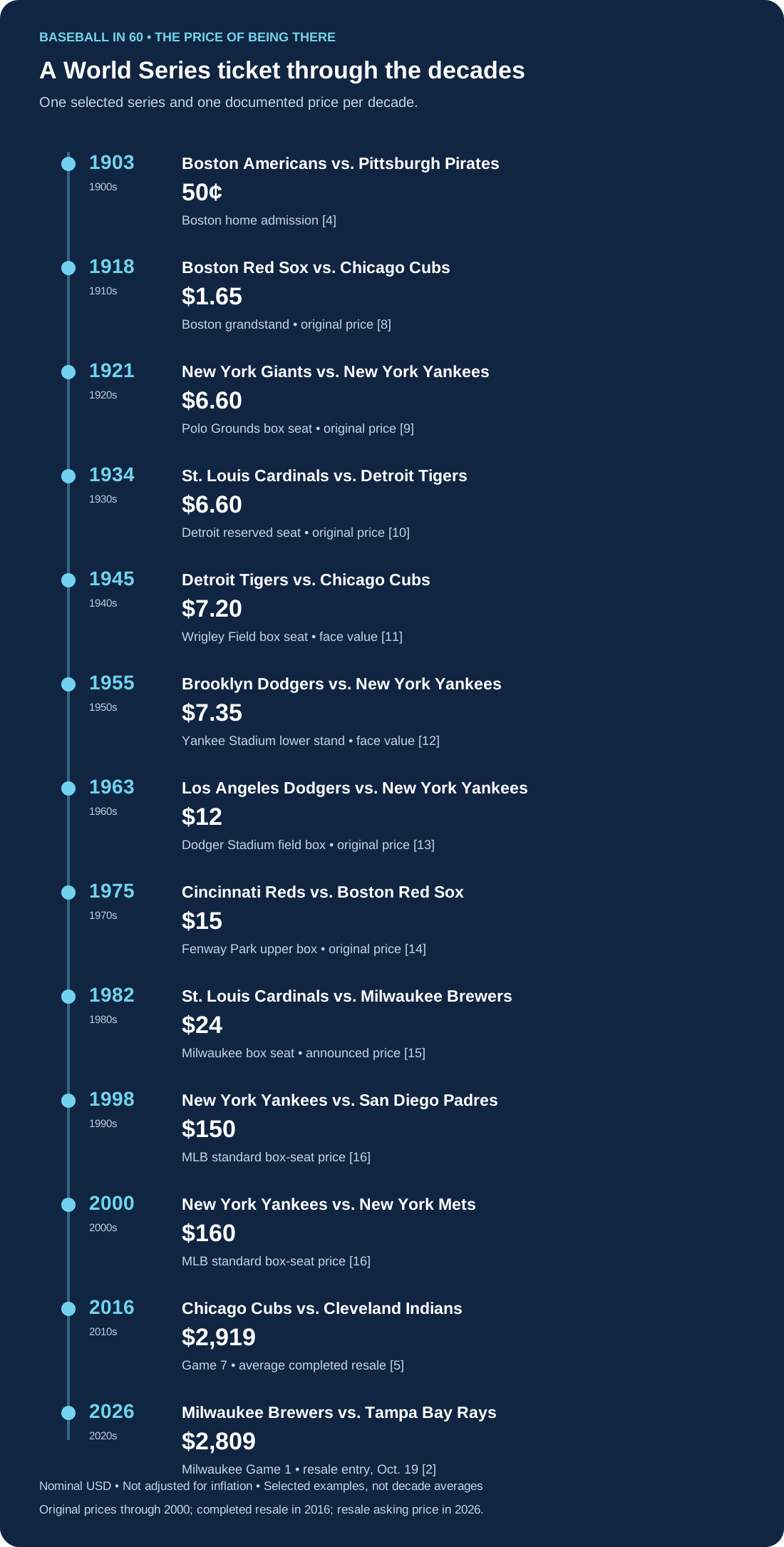
The timeline shows one selected World Series from every decade, with the actual teams and one documented ticket price. These are individual examples, not decade averages. Prices through 2000 are original admission or standard box-seat prices; 2016 is an average completed resale, and 2026 is a reported resale asking price. All amounts are nominal U.S. dollars, without inflation adjustment. Seat categories and methods differ, so this is not a like-for-like price index.
1903: a very different baseball business
The Library of Congress notes that Boston charged fifty cents admission for its home games during the first modern World Series in 1903. That figure offers a striking starting point, although it should not be interpreted as the price of every ticket category across both cities. [[4]](#source-4)
The contrast with today reflects more than inflation. Modern championship attendance operates within a national travel market, a sophisticated resale business and an entertainment economy built around scarce experiences. Fans can compare listings across the country within seconds.
That accessibility has two sides. It makes buying from far away easier, while exposing a local supporter to competition from buyers who do not live anywhere near the stadium. The event becomes available to a much broader audience without adding seats.
2016: the championship-drought premium
For 2016 Game 7, reported averages were $4,700 asking and $2,919 paid. [[5]](#source-5)
The gap is instructive. A seller’s expectation and a buyer’s payment are not the same thing, even in a market charged with extraordinary anticipation. Historical comparisons work better when that distinction survives the headline.
For Milwaukee supporters, the broader parallel is emotional. When a championship opportunity has been absent for decades, waiting for next year does not feel like an equivalent alternative. Buyers may value certainty more highly because they cannot know when another chance will arrive.
2023: the host city changed the bill
In 2023, sales averaged $763 in Phoenix and $1,167 in Arlington. [[6]](#source-6)
Those numbers illustrate why “a World Series ticket” is too broad a category for serious budgeting. Different venues within the same series can produce substantially different markets. The sporting stakes may be shared, but local demand and available inventory are not identical.
A travelling fan should therefore compare complete itineraries for both cities. The cheaper ticket can justify a longer journey, but only if the airfare, accommodation and transport costs do not erase the saving.
2024: famous brands brought another surge
The Yankees–Dodgers matchup generated another wave of expensive listings. Yahoo Sports reported Game 1 average resale prices of $1,731 on SeatGeek, $1,703 on TickPick and $1,682 on Vivid Seats in a pre-series snapshot. [[7]](#source-7)
Those platform differences are a reminder that even simultaneous coverage does not necessarily measure identical inventory. Buyers may find different seats, quantities and seller expectations across marketplaces. An apparent price discrepancy does not automatically mean one report is wrong.
Together, these examples suggest a more useful historical lesson than a simple upward line: World Series prices depend heavily on who reaches the final, where games are played and what buyers believe they might witness.
Are tickets still available when the game is “sold out”?
A sold-out primary allocation does not necessarily mean there are no tickets left to buy. Existing ticket holders can offer their seats through resale channels. Availability and price can therefore change after the original public sale has ended.
Begin with the participating club’s official postseason ticket page to identify the authorized route. Then compare reputable resale platforms, checking the same game, section, quantity and final payable amount. A lower advertised number is not helpful if it describes a different product.
Be particularly careful with home-game numbering. A club’s first home game may be Game 3 of the series. Confirm the venue, calendar date and series game before paying. For later games, examine what happens if the matchup ends before that game is required.
The full trip: an illustrative two-person budget
Consider two adults flying in for one game and staying two nights in a shared room. The following amounts are planning assumptions, not researched flight or hotel quotations. They show how the total changes when the ticket market changes.
Illustrative budget for two adults • USD • Not live travel quotations
| Expense | Milwaukee | Tampa Bay |
|---|---|---|
| Two tickets | $5,600 | $2,000 |
| Return flights for two | $1,200 | $1,200 |
| Shared hotel, two nights | $700 | $700 |
| Ground transport / parking | $250 | $250 |
| Meals and incidentals | $350 | $350 |
| Illustrative total | $8,100 | $4,500 |
The Milwaukee example totals $8,100; the Tampa Bay example totals $4,500. Both assume identical non-ticket spending to isolate the admission-price difference. Real itineraries could reverse some of those savings through more expensive flights or accommodation.
A local resident might eliminate most of the travel bill. A family buying four admissions could face a much larger total. The useful exercise is to build the complete budget first, rather than treating the ticket as an isolated purchase and discovering the other expenses afterward.
Flights, hotels and the hidden cost of flexibility
Airfare depends on departure airport, connections, baggage and booking timing. Accommodation depends on location, room availability, taxes and cancellation terms. A hotel that appears cheaper can become less attractive after repeated journeys to the stadium are included.
For Milwaukee, compare a nearby airport only after calculating ground transport and the time required. For Tampa Bay, check the distance between the airport, hotel and the St. Petersburg ballpark. A regional destination name does not guarantee a short transfer.
Refundable arrangements can cost more upfront but reduce exposure if plans change. That is especially relevant for Games 5, 6 and 7, which may not be played. A ticket refund would not necessarily recover a nonrefundable airline booking or hotel reservation.
Canadian supporters should also budget in Canadian dollars before committing. The U.S.-dollar ticket price is only one part of the eventual card charge; conversion rates and card fees affect the total. Use the rate and terms applicable when booking rather than an assumed conversion.
Should fans buy now or wait?
There is no dependable rule that World Series tickets always become cheaper near first pitch. Waiting can help when sellers compete to unload inventory, but it can hurt when available supply shrinks and more buyers arrive.
The October 19 Milwaukee report provides a warning against assuming prices must fall: Front Office Sports said its tracked Game 1 get-in price had risen 41 percent over three days. That observation describes a particular period, not a forecast for the next one. [[2]](#source-2)
A practical approach is to decide the maximum total trip cost in advance. If a suitable ticket and itinerary fit that limit, buying provides certainty. If they do not, waiting should remain an option alongside staying home—not an open-ended commitment to pay whatever appears later.
Travellers need to consider two markets simultaneously. Saving on admission is less valuable if the delay produces a larger airfare increase. Local supporters usually have more freedom to watch ticket prices without that additional complication.
Ways to spend less without losing the experience
Compare single seats with pairs if your group is comfortable sitting separately. Investigate upper levels and standing room carefully, including sight lines and accessibility. Measure value by the experience you want rather than assuming the lowest listed price is automatically the best purchase.
Consider whether attending an earlier game satisfies the goal. The possibility of witnessing a championship clincher is exciting, but a potential later game creates scheduling uncertainty. Being inside the park for any World Series contest may be the memory that matters most.
Keep discretionary costs visible. Meals, merchandise, parking and extra nights can expand a carefully planned trip. Setting a separate allowance for those purchases helps preserve the budget without requiring constant decisions once the excitement begins.
What is the experience worth?
There is no universal answer. A supporter who has saved for years may reasonably choose a special trip. Another may prefer a watch party, several future ballpark visits or the financial breathing room of keeping the money.
The strongest purchasing decision starts with an honest distinction between emotional value and financial capacity. A memorable night does not become more meaningful because the buyer selected a more expensive section or ignored a spending limit.
For 2026, the immediate answer is clear: reported Milwaukee entry prices near $2,800 made admission a major purchase, while the cited Tampa Bay options were closer to $1,000. But history offers the more lasting insight. Fans are buying a chance to say they were there—and the cost of that chance changes dramatically from one October to the next.
Sources and price notes
Research checked October 20, 2026. Resale prices and inventory change continuously. Historical figures refer to the specific games, platforms and measures identified above; they are not directly comparable annual averages. Travel amounts are editorial budget assumptions.
Sources
- 1. Associated Press, Oct. 20, 2026: matchup and franchise history
- 2. Front Office Sports, Oct. 19, 2026: TicketData pricing snapshot
- 3. Forbes, Oct. 19, 2026: SeatGeek pricing snapshot
- 4. Library of Congress: First World Series Ticket
- 5. Fortune / Money, Nov. 2, 2016: Game 7 TicketIQ figures
- 6. Axios Phoenix, Oct. 30, 2023: StubHub completed-sales averages
- 7. Yahoo Sports, Oct. 23, 2024: Game 1 platform averages
- 8. SABR: Broadcasting Red Sox Baseball — 1918 Boston grandstand prices
- 9. SABR: 1921 Yankees–Giants series — box seats
- 10. Golden Rankings: The Ultimate Game, 1934 — Detroit reserved seats
- 11. DNAinfo, Oct. 27, 2016: 1945 Wrigley Field original box-seat prices
- 12. Grey Flannel Auctions: 1955 ticket set — printed face values
- 13. FOX Sports: World Series ticket-price perspective — 1963 field box
- 14. The Harvard Crimson, Nov. 4, 1975: Fenway upper-box ticket prices
- 15. Brewers 1982 historical archive: announced Milwaukee box-seat price
- 16. Seattle Post-Intelligencer, Aug. 23, 2001: standard box prices in 1998 and 2000
- 17. Baseball-Reference: World Series teams by year; historical franchise names retained